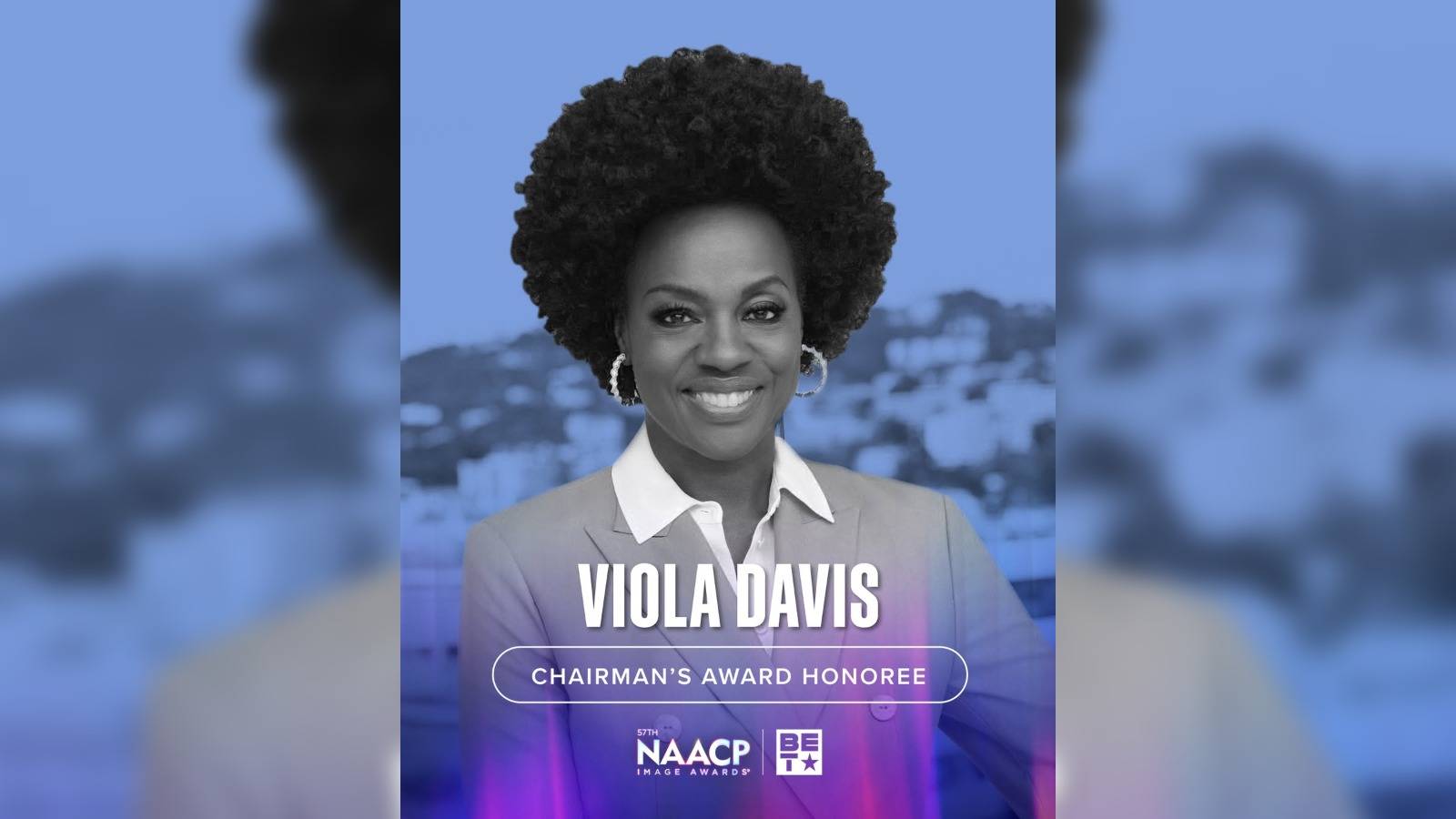
Viola Davis Honored With Chairman’s Award at the NAACP Image Awards

On a night dedicated to celebrating Black achievement, Viola Davis stood at the center of it all. During the 57th NAACP Image Awards, where the Chairman’s Award was presented by Capital One, the EGOT winner was honored for a career defined not only by groundbreaking performances but by purpose-driven leadership beyond the screen.
The Chairman’s Award recognizes individuals who use their platform to drive meaningful change, and Davis’ trajectory makes the honor feel less like a milestone and more like a confirmation of what audiences have long understood.
Already a nine-time NAACP Image Award winner, Davis has spent decades building one of the most formidable bodies of work in modern entertainment. From her Academy Award-winning performance in Fences to her commanding portrayal of the Mother of the Blues in Ma Rainey’s Black Bottom, she has consistently chosen roles that center complexity, vulnerability, and unapologetic Black truth.
Her Emmy-winning turn as Annalise Keating in How to Get Away With Murder changed television history, making her the first Black woman to win Outstanding Lead Actress in a Drama Series. It wasn’t just a win — it was a cultural shift. Davis used that platform to call out the lack of opportunity for women of color in Hollywood, reminding the industry that talent is universal, but opportunity is not.

Then came The Woman King. Davis didn’t just star in the historical epic — she trained rigorously, produced it, and helped shepherd a story about African women warriors to global audiences. The film’s success underscored her influence both in front of and behind the camera, proving that stories centered on Black women can lead at the box office and in cultural conversation.
Her recent work in the action-thriller G20 shows she is still pushing herself creatively. While many actors in her position might coast on legacy, Davis continues to expand her range, embracing physically demanding and genre-bending roles with the same emotional precision that defines her dramatic performances.
But what truly distinguishes Davis, and what made Saturday night’s recognition resonate so deeply, is the way she has paired artistic excellence with service. Through the Davis-Tennon Foundation, launched alongside her husband Julius Tennon, she has invested in underserved communities, focusing on poverty alleviation, education, and empowerment. She has also partnered with initiatives to eradicate childhood hunger, an issue she speaks candidly about given her own experiences growing up in poverty.
Her acceptance remarks reflected that dual focus. She spoke not just about achievement, but about responsibility — about using visibility as leverage for equity and justice. It was less a victory speech and more a reaffirmation of commitment.
The honor also places Davis in distinguished company. Previous Chairman’s Award recipients include Vice President Kamala Harris, Amanda Gorman, Samuel L. Jackson, Ruby Dee, and the late Congressman John Lewis — leaders whose impact extends far beyond their professions. Davis’ inclusion in that lineage feels fitting.
In recent years, she has also received the Cecil B. DeMille Award at the Golden Globes, been inducted into the Television Academy Hall of Fame, and earned an honorary doctorate from the American Film Institute. Yet even with a shelf full of accolades, her work remains rooted in something deeper than recognition.
Davis has spent her career demanding that the world see Black women in their fullness — flawed, powerful, vulnerable, victorious. The Chairman’s Award simply formalizes what her impact has already made clear: her legacy is not just about the roles she has played, but the doors she has forced open.