Road To The Image Awards: Sterling K. Brown Leads With Range And Partnership

For Sterling K. Brown, excellence has never been a one-lane road.
It’s been a multi-hyphenate highway paved with emotional depth, commanding presence, and a rare ability to shapeshift between characters without ever losing the humanity that anchors them.
As the Road to the NAACP Image Awards spotlight turns toward this year’s stacked field of nominees, the actor once again stands tall among the industry’s most formidable talents, which is a testament not only to his consistency but to his unmatched versatility as a performer.
Whether he’s leading a primetime drama like “Paradise” or delivering scene-stealing support in a limited series, Brown operates with an intentionality that elevates every project he touches.
Audiences first fell in love with his layered vulnerability as Randall Pearson on “This Is Us,” a role that required him to navigate anxiety, adoption, Black identity, and familial responsibility with grace and emotional precision.
But what makes the seasoned star’s career so compelling is how seamlessly he pivots.
He’s never allowed himself to be boxed into one emotional register or genre lane.
From political thrillers to intimate character studies, Brown has built a resume defined by range.
He can command authority, embody tenderness, project quiet internal conflict, or explode with righteous conviction, often within the same performance.
It’s this elasticity that continues to make him one of Hollywood’s most trusted dramatic anchors. Directors rely on his emotional intelligence, while audiences trust his authenticity.
That dynamic range is once again being recognized at this year’s NAACP Image Awards, where Brown has earned two major nominations for Outstanding Actor in a Drama Series and Outstanding Supporting Actor in a Television Movie, Limited-Series or Dramatic Special.
In a year filled with powerhouse performances and stacked talent across categories, his double nomination speaks volumes. It signals not just productivity, but impact and the kind that resonates across formats, networks, and storytelling styles.
For the “Army Wives” star, recognition from the NAACP carries a weight that industry accolades alone cannot replicate.
“Getting recognized by your community is incredibly special,” he says with intention.
“Everything that I do, I’m so intentional and I think most Black artists are with the idea of not setting us back. We do not want that at all whatsoever.”
For the actor, the NAACP Image Awards represent more than performance recognition; they reflect responsibility for how Black life is portrayed and preserved onscreen.
“You recognize the power of images out into the world… the tapestry, the landscape of how the world at large will observe us as a people,” he explains, emphasizing the need for layered portrayals.
That’s why his performances consistently resist stereotypes. As he puts it, the goal is to offer characters who feel “multi-layered and multi-dimensional… real and lived in.”
Holding nominations across two different performance lanes feels, to him, like affirmation and not of visibility, but of instinct. The “This Is Us” star describes his career navigation as less strategy and more surrender.
“I sort of let God decide,” he says, reflecting on the danger of overanalyzing opportunities.
Over time, he’s learned to trust alignment with strong writing, generous collaborators, and creative spaces rooted in shared intention rather than ego.
He’s mindful that this clarity came with evolution. Earlier in his career, the focus was volume, making auditions, guest spots, and showing up wherever the door cracked open. Now, the lens is legacy.
“I find myself acting less, but on bigger projects,” he says, describing the shift toward producing, building, and attaching his name to work more intentionally.
With that expansion comes new pressure and the awareness that what he co-signs now carries weight.
As he puts it, “the game is being played in a different way.”
That growth extends into cultural impact as well, particularly in how he portrays Black masculinity onscreen.
Brown doesn’t frame his emotional openness as a calculated choice, but rather an authentic inheritance.
“For me to have success, I have to show up as authentically as possible,” he says.
He recalls early auditions where he tried channeling other actors, even mimicking Denzel Washington, only to realize imitation wasn’t the assignment. His individuality was.
“The one thing that I have going over everybody else is that I am Sterling K. Brown.”
That self-possession was shaped at home, especially through the emotional example set by his father. Brown describes watching films together, both of them visibly moved, and a memory that normalized vulnerability rather than suppressing it.
Affection, he says, was never rationed.
“Hugs and kisses were regular for me from my father,” he recalls, challenging the notion that emotional expression weakens masculinity.
In his view, affection is clarity. “I love you… unequivocally,” he expressed.
That emotional fluency feeds directly into his range as an actor.
Versatility, he explains, wasn’t accidental, but it was trained.
“So the versatility is very intentional. I just try to give different colors,” he says, referencing the technical foundation he built in grad school to ensure he could meet any role with depth.
But craft alone isn’t what sustains his elasticity as curiosity does.
The seasoned veteran speaks about studying people, not just characters, and approaching performance as an exercise in empathy.
He calls it “the ultimate exercise in empathy,” rooted in a desire to understand how others move through the world.
That philosophy extends beyond acting into his personal ethos, from loving people fully, without conditions or distance.
The work, in many ways, is just one expression of that larger mission.
Even conversations about recognition are filtered through gratitude. Brown is acutely aware of how rare sustained employment is in his field, which keeps his perspective grounded.
“To have a job is a blessing in and of itself and to do good work is its own reward,” he says.
He doesn’t ignore industry inequities as he’s clear about underrepresentation and structural imbalance, but he refuses to let frustration calcify into bitterness.
Instead, he practices release, focusing on what he can control while acknowledging the uphill climb.
“In the midst of moving the boulder uphill, I try to bask in the shade that the boulder provides,” he says, which is a metaphor that captures his balance between realism and optimism.
Offscreen, that intentionality carries over into his marriage with fellow actor Ryan Michelle Bathé, a partnership approaching 20 years.
He speaks about her with admiration, describing her as “immensely talented and incredibly driven,” someone whose perspective sharpens his own.
Their relationship, he explains, thrives on both difference and alignment. Where he brings lightness, she brings grounding. Where he expands, she refines.
“I try to point her towards where's the lightness and she points me to where I can shine my light into the darkness.”
Even the practical mechanics of their partnership, from career conversations to red carpet appearances, require navigation.
He’s learned when to share industry updates, when to protect emotional space, and when to step back.
And when it comes to public moments, their interpretations don’t always match.
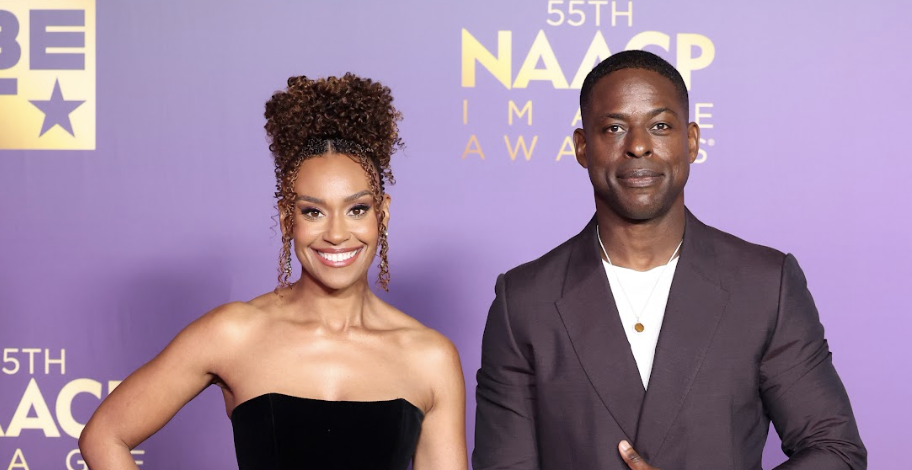
“What the carpet represents to her versus what it represents to me is slightly different,” he admits with a laugh.
For him, it’s recognition. For her, it’s visibility and an opportunity to be seen on her own terms.
That difference, he jokes, has led to ongoing negotiations over styling, photographers, and production, all elements he once underestimated.
But at the core of it is mutual advocacy because, as Brown sees it, those moments aren’t just about individual wins as they’re collective ones.
“It is a moment for her… it is a moment for me… but it's also a moment for us to show up and stunt a little bit.”