Andra Day Says Her Latest Role As The Only Black Person in the Film Doesn’t Make Her a Token

Bradley Cooper’s “Is This Thing On?” opens with a marriage edged toward its end, then it lets its characters stumble into self-discovery, laughter, and a few sharp truths.
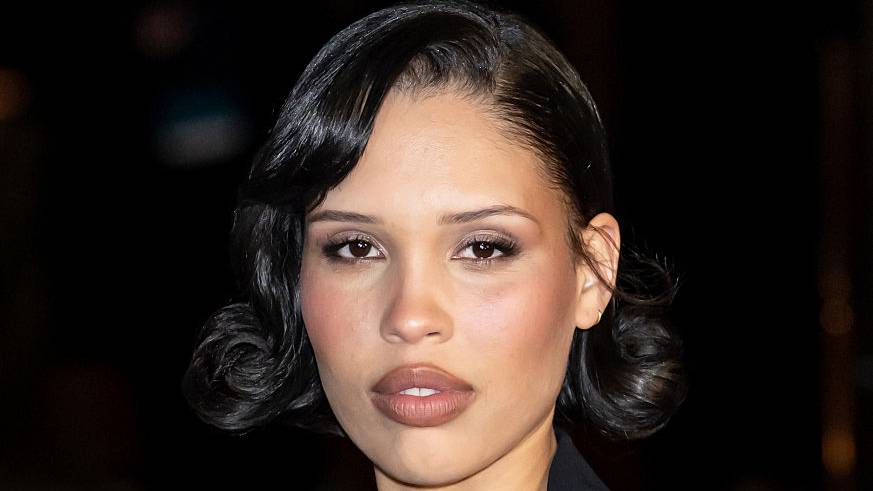
Amid a mostly white ensemble cast, Andra Day as “Christine” quietly does something rarer than showy stereotypes: she arrives whole. That choice, to play a Black woman who’s layered, funny, blunt, wounded, and vocally inclined, is the soul of Day’s performance, and it’s something that she and Cooper crafted with care.
“Sometimes being the only Black person in a friend group… I don’t know if it’s pressure,” Day told BET Current exclusively. “I have a desire and a deep desire to represent the multifaceted diaspora… to represent how multifaceted we are as a people.” That insistence informed everything from Christine’s backstory to tiny, telling choices like why she sings “Amazing Grace” at breakfast, why she names the ways she pushes people, and why she gets the sharp truth in a moment that cuts through the main couple’s drama.
Cooper told Day the night before filming, the song was a late idea, “and I was like, whatever is going on in your head, let’s pursue it,” she said. The result gives the character a private ritual that communicates history, faith, and endurance in a few notes.
Day and Cooper also insisted Christine wouldn’t be a flattened “token” – a decorative dash of color to make the cast look diverse. “Sometimes those type of characters can be flattened,” Day said. The film answers that worry on its own terms. Christine has her own arc beats; she provokes insight in others, and she’s allowed that messy mix of anger, confession, and grace that real people carry. That’s notable in an industry where leading roles for Black actors, and especially Black women, remain under pressure. The UCLA Hollywood Diversity Report (2025) found that Black actors remain underrepresented in theatrical film roles, underscoring how rare fully dimensional parts still are.
Critics have noticed the difference. Early reviews praised Cooper’s restrained direction and the ensemble’s chemistry. They call the film a bittersweet dramedy that lets its supporting players matter rather than simply orbit a male protagonist’s arc. “Is This Thing On?” premiered at film festivals to solid notices for Will Arnett’s leading role and for the way the movie lets relationship truths emerge slowly in front of the camera.
Day said those textures came from deep conversations on set. “Bradley is… a gem in the entire cast because his goal at the end of the day is always a relentless pursuit of truth,” she told BET. “The last thing he ever wanted to do was cast someone and be like, ‘Oh, she’s kind of just one note.’” That creative rigor shows. Day’s “Christine” can be prickly, tender, funny, moral, and crucially contradictory–this is the kind of on-screen humanity that stifles stereotypes. Academics and writers who study Hollywood’s portrayals of Black women have argued for this very complexity for decades, calling out how token roles or flattened archetypes erase real lives and close off empathy. “Is This Thing On?” opts for the opposite.
Why this matters beyond the film critics’ pages is a question of cultural optics and opportunity. When Black characters are allowed interiority — when faith, humor, cynicism, pain, and joy sit in the same scene — audiences get full humans, not reminders that race can be reduced to a punchline or plot device. Day pushed for Christine’s specificity (where she went to school, how her family shaped her, how she fits into a New York-set friend group) because those facts explain how she could be both a moral center and an irritant. “We wanted to make sure that we represented her in a really truthful way as a part of a multifaceted Black experience,” Day said.
Hollywood’s diversity gains are still uneven. Recent reporting shows progress in casting, but persistent shortfalls in lead roles and behind-the-camera power. When a Black supporting character is fully realized, it increases the visible pipeline for future writers, directors, and actors to demand more than token inclusion. As Day told BET Current, she chose Christine in part because the role offered something she wanted to practice: being direct, speaking truth, and modeling grace for herself. “I gravitate toward characters that have something that I want,” she said. “So that I can make a practice of it.”
“Is This Thing On?” isn’t political. It’s a relationship movie that gets representation right by refusing to settle or phone it in. Its smallest gestures — a church hymn at breakfast, a frank conversation delivered on a sofa, a Black woman’s textured moral center- add up to a powerful argument: representation matters when it’s real. Andra Day’s “Christine” proves that being the only Black face in a room doesn’t have to be the character’s only story.